
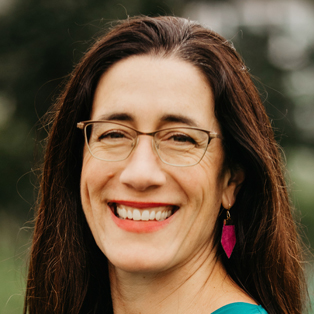
Hello friends and colleagues!
Thank you, as always, for the work you are doing — and for the partnership you continue to extend to Roots & Wings.
There is no need to overstate current conditions. Many of you are experiencing them firsthand: rising strain on families, increasing uncertainty around public funding, and a social safety net that feels less reliable than it did even a few years ago. For many of you, this is showing up in your budgets, your staffing, and the day-to-day realities of trying to serve communities with fewer guarantees and more volatility.
We want you to know that we see that clearly.
At Roots & Wings, we are trying to meet this moment in ways that are practical and responsive. We increased our overall grantmaking, accelerated some grant payments to move resources more quickly, and provided some capacity-building support for organizations navigating leadership transitions or operational strain. We are also spending more time collaborating with peer funders — sharing information, aligning where we can, and trying to respond with greater coherence to what is shifting around us.
None of this resolves the larger forces at play. But we hope it signals that we are here, paying attention, and committed to showing up as a partner in ways that are useful.
At the same time, this period of uncertainty has clarified something important for us. It has amplified our long-standing commitment to the earliest years of life — from prenatal through age three.
The evidence has not changed. If anything, it has become more difficult to ignore. Brain development begins before birth and accelerates at a pace that is unmatched at any other point in life. In those first years, the foundations for learning, emotional regulation, physical health, and resilience are being built — shaped by relationships, environments, and the presence or absence of stability. When those conditions are strong, the benefits extend across a lifetime. When they are not, the consequences can be profound and difficult to reverse.
As stewards of philanthropic resources, we are increasingly convinced that this is where focused investment can have the greatest long-term impact. It is also where the risks of disinvestment are most consequential.
That is one reason we are proud to feature ZERO TO THREE in this issue of the newsletter. For nearly five decades, they have helped build the scientific, programmatic, and policy foundation for supporting infants and toddlers in this country — and they continue to lead at a time when that leadership is urgently needed. From embedding developmental expertise in pediatric care settings to advancing a coordinated national policy agenda for young children, their work reflects what sustained, disciplined commitment to this field can achieve.
We also recognize that meeting this moment requires continued investment in our own capacity. We are pleased to welcome Leah Bradford Francis as our new Managing Director, and to share that Jamie Carroll and Sophia Lopez have taken on expanded roles as Program Director and Grants Manager, respectively. These changes reflect our effort to stay responsive, thoughtful, and better aligned with our partners’ needs.
Finally, I want to acknowledge something that sits heavily with us. The challenges we are navigating domestically are part of a broader global pattern. As investments in international development and global health contract, the consequences for very young children are immediate and severe.
Programs addressing food security, maternal health, and preventable disease are being scaled back or eliminated. For the first time in decades, child mortality is projected to rise — with the greatest impact falling on children under five, and especially those in the earliest years of life.
The connection is not abstract. Whether a child is born in the United States or elsewhere, the prenatal-through-three window represents the same period of extraordinary opportunity — and vulnerability. The question, in every context, is whether the conditions exist for that child to grow and thrive, or whether they do not.
That is the work in front of all of us.
Even in a time like this — maybe especially in a time like this — I remain hopeful. Not because the path ahead is easy, but because the importance of the work is so clear. The earliest years of life are where human potential begins to take root. There is still opportunity to shape that trajectory for the better.
The children and families we are working for don’t have the luxury of despair. Neither do we.
With appreciation,
Shana

In a moment of unprecedented risk to the programs and policies that support infants and toddlers, one organization has spent nearly five decades ensuring that every baby gets the strong start science tells us they deserve.

Every second of the first three years of life, more than one million neural connections form in a baby’s developing brain. Those connections — shaped by every conversation, every touch, every moment of comfort — lay the foundation for everything that follows: how a child learns to trust, to communicate, to navigate the world. They are, in the most literal sense, the architecture of a human future.
For nearly five decades, ZERO TO THREE has made it their singular mission to protect and nurture that architecture. Founded in 1977 as the National Center for Clinical Infant Programs, the organization has grown from a small community of researchers and clinicians into the leading national voice for infants, toddlers, and their families — now with a staff of more than 225 and an annual operating budget of approximately $60 million. Driving that growth, for more than 31 years, has been Executive Director Matthew Melmed.
Roots & Wings Foundation is proud to count ZERO TO THREE among our grantee partners. Their mission aligns precisely with our own conviction that the prenatal-to-three window is the most consequential period in human development — and that investments made during these years pay dividends across a lifetime.
When Melmed arrived at ZERO TO THREE in the mid 1990s, the organization had 13 staff members. He came not as a clinician — by his own admission, he didn’t know what a ‘dyad’ was — but as someone with roots in public policy, legal and human services who quickly fell in love with the science of early childhood. What he found was a field brimming with knowledge but surrounded by public ignorance and indifference.

ZERO TO THREE Executive Director Matthew Melmed
The explosion of brain science research in the early 2000s gave the field a powerful new vocabulary. And Nobel Prize-winning economist James Heckman at the University of Chicago provided the economic proof: every dollar invested in a child under three returns up to thirteen dollars in long-term societal benefits — higher graduation rates, lower health costs, reduced crime and incarceration.
“It’s also common sense,” Melmed explains. “If babies and toddlers have strong support when their brains and identity are forming — healthy relationships, positive experiences, less exposure to prolonged anxiety or trauma — you’re less likely to see those burdensome personal and societal costs show up later.”
Among ZERO TO THREE’s most consequential contributions to the field is Healthy Steps — an evidence-based program that places child development and behavioral health promotion and prevention specialists directly inside pediatric primary care practices. The concept is elegantly practical: parents of babies and toddlers already take their children to the pediatrician. Why not bring developmental expertise to where families already are?
Melmed traces the idea to his earliest days at ZERO TO THREE. Pediatricians, he explains, are not trained — or given nearly enough time — to address the developmental and behavioral concerns that are, in fact, parents’ most pressing questions. The Healthy Steps model addresses this gap by embedding a HealthySteps Specialist into the primary care team: a social worker, infant mental health professional, or community-based practitioner who can observe babies, listen to parents, identify early signs of developmental delay, and connect families to the support they need.
“Toddlers and young children often don’t have the words,” Melmed notes, “but their behavior has meaning. You need someone who can interpret that meaning, help parents understand it, and connect them to the supports they may need.”
The program was first piloted in 1996. Parents loved it. Pediatricians loved it. But there was no reliable mechanism to pay for it at scale, and the model grew erratically for years. In 2015, ZERO TO THREE took full ownership of the program — tightening the evidence base, building standards and training infrastructure, and launching an ambitious national scale-up. By 2025, Healthy Steps was reaching more than 525,000 children and families across 377 sites in 25 states. The goal is to reach at least one million children and families annually by 2032.
Critically, the program prioritizes children enrolled in Medicaid or the Children’s Health Insurance Program (CHIP) or without insurance — those who face the greatest barriers to accessing early support. And it is helping reshape American pediatric care more broadly, operationalizing a vision the American Academy of Pediatrics has long held.
If Healthy Steps reaches families through the doctor’s office, another flagship program — Safe Babies — reaches them through an even more unlikely front door: the child welfare system.
In the United States, a baby or toddler is removed from their family every ten minutes due to an allegation of maltreatment or neglect. Children under three make up roughly one-third of all children in foster care — the single largest age group in the system — and yet they have historically received the least attention and the fewest targeted services. ZERO TO THREE built Safe Babies to change that.
The initiative brings together judges, child welfare agencies, and community partners to build a coordinated web of support around families with very young children. Its goal is not only to improve outcomes within foster care, but to prevent foster care altogether — getting families the services and support they need before a crisis ever reaches a courtroom.
“We started in the court system,” Melmed explains, “training judges so they could be champions for babies and use their understanding of the science of child development in making decisions for families.” While the Safe Babies approach started 20 years ago, anchored in the court system, it is an entry point for cross-system collaboration and early childhood system building to effectively serve very young children and their families across the promotion, prevention, and treatment continuum.
Today, Safe Babies operates across more than 150 locations in 31 states. Children enrolled in the program are nearly twice as likely to reach a permanent home compared with the general foster care population. At least 83 percent receive a developmental screening and early intervention services within 60 days. The results reflect a simple but powerful truth: address the need early, and you change the trajectory.
ZERO TO THREE has always understood that programs, however excellent, cannot function without supportive public policy. And in the current environment, policy is the most urgent arena of all.
Federal spending on babies and toddlers currently stands at approximately $1.59 out of every $100 in the federal budget — a figure that already reflects a 20 percent decrease since 2021, and one that does not yet account for the most recent rounds of cuts to Medicaid and SNAP. Against this backdrop, Melmed and ZERO TO THREE moved proactively. Well before the 2024 election, they reached out to nearly 40 national partner organizations — including the March of Dimes, the American Academy of Pediatrics, the National Black Child Development Institute, and Child Care Aware of America — to form the Prenatal-to-5 Policy Network, a coordinated federal advocacy coalition for which ZERO TO THREE serves as the backbone organization.
The network has already demonstrated its value. Some of the most severe proposed cuts to Medicaid and SNAP were blunted. Calls for the outright elimination of Head Start and Early Head Start — the latter which ZERO TO THREE was instrumental in creating and has supported for nearly three decades — were turned back.
“It could have been worse,” Melmed says simply. “And so, that’s a win.”
The network is also engaged in documenting harm — bearing witness to what service reductions mean in the daily lives of real families — and in the longer-term work of reimagining what a coherent, family-centered federal support system could look like.
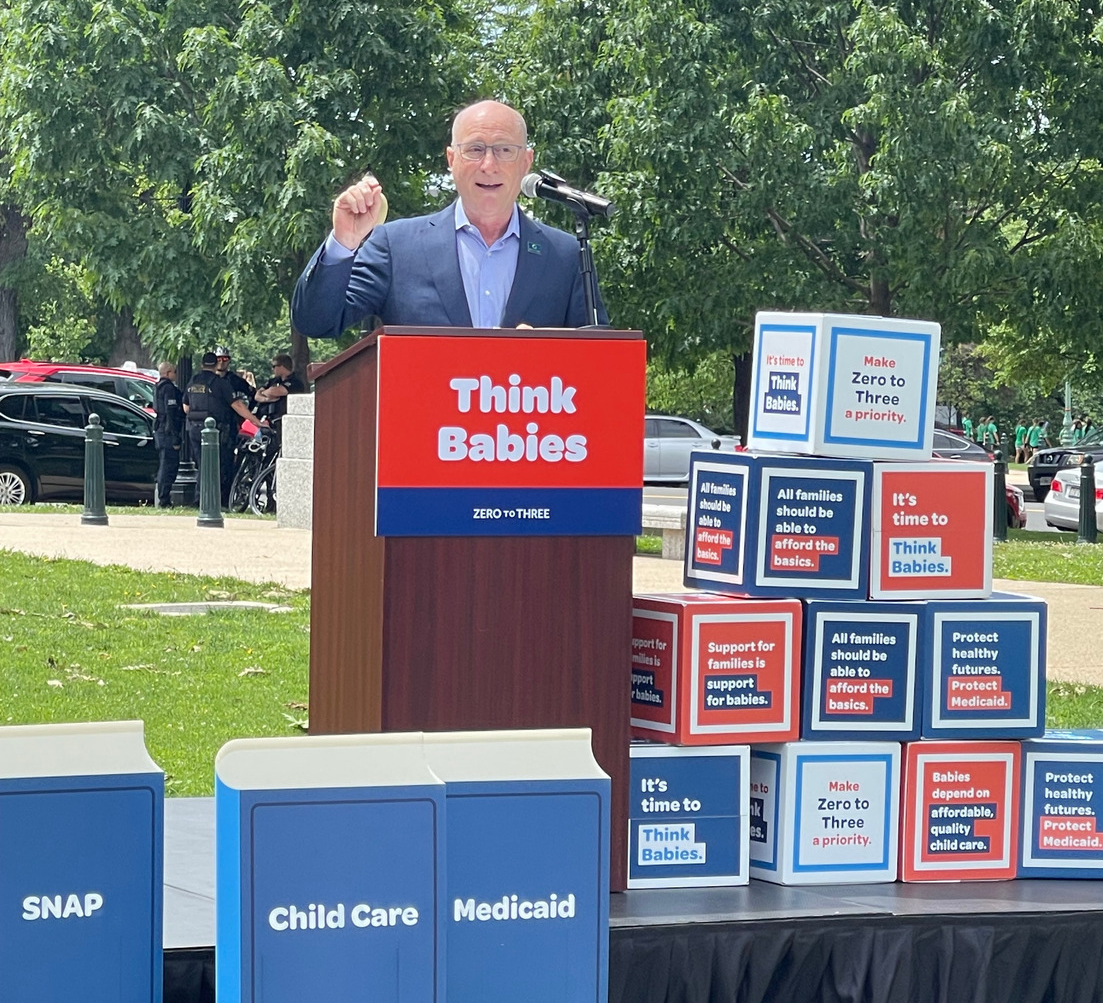
Matthew Melmed at Strolling Thunder 2025
“The so-called ‘system’ we have isn’t really a system,” Melmed says. “It’s a Rube Goldberg contraption that evolved over many years. The challenge is can we reconceptualize, visualize and implement a coherent and comprehensive set of policies and programs, based on what families tell us they want and what research shows really works.”
Beyond P-5, ZERO TO THREE’s own policy network connects nearly 75,000 individuals seeking information and action opportunities. In 2025 alone, that network generated more than 40,000 messages to federal policymakers on behalf of infants and toddlers. And to help families add their own voices, ZERO TO THREE has run Strolling Thunder for ten years — bringing parents and caregivers from every state to Washington, D.C. to meet with their elected representatives, with their stories amplified far beyond the capitol through social media.

As the work of Roots & Wings evolves and expands, so too does our dedicated staff. We are thrilled to introduce you to our newest team member, Leah Bradford Francis, who joins as the foundation’s first Managing Director. Below, Leah describes the journey that led her to Roots & Wings, and the aspects of her new role that most excite her. Additionally, we are thrilled to share that two of our team members have taken on expanded roles – Jamie Carroll as Program Director and Sophia Lopez as Grants Manager. Please join us in congratulating all three of these remarkable people on their new roles and responsibilities!
Tell us about your role at Roots & Wings and what brought you to this work. As the Managing Director, I support the organization’s Operations and Program teams. I am especially excited about the opportunity to learn from our partners who are doing amazing things in support of children and families. My time spent serving as an Americorps VISTA volunteer with Habitat for Humanity in California and Malawi provided me with a transformational experience in my early 20s. From that experience grew my desire to focus my career on things that matter – to improve the quality of life for others and ensure that the needs and dreams of families are fulfilled.
You’ve seen philanthropy from multiple vantage points in your career, and served in a number of roles to help build/strengthen growing organizations. What excites you about the next phase in Roots & Wings trajectory? Roots and Wings’ trust based approach to partnership is inspiring and so critically needed in the field. Across my career in corporate, philanthropy, and nonprofit sectors, I’ve learned that building trust is paramount. Trust between people, within organizations, across communities, and across sectors is very fragile, yet critically important for collaboration and collective problem solving. As Roots & Wings continues to grow and expand, I’m excited about the impact it will have not only with more partners but also on the sector at large, leading with trust and centering communities.
You’re the mother of a six year old, and you also lived abroad recently. How have either/both of those experiences shaped your view of philanthropy and its potential (or responsibility) to effect positive change for children and families? Everyday I think about the world and environment in which my beautiful black boy will grow up. How can I ensure that he thrives, and not just survives? I don’t have an answer; but I do believe there is a need for equity and love to ensure all children, not just my son, have an equal chance to shape and fulfill their self-determined futures. It is a shared responsibility. Philanthropy, government, and the private and social sectors each have a role to play. We, as humans, have a role to play. At Roots & Wings, I’m excited to partner with people and organizations that believe in a world where all children can grow, learn, be safe, and find joy.
How do you spend your free time? Keeping up with my high energy son, enjoying non-fiction books and podcasts, and traveling!